Joker Tricks characters: Jinxie, Jest and Luna
Three figures stand above the reel field, and they are not decoration bolted onto an unrelated machine. The studio's own description makes them the organising idea of the game: each commands a colour, each pulls tokens, and how many of them are awake at once is what decides which bonus tier the game is in.
That is the part everyone repeats. The part almost nobody writes down is what each one is individually for — and the game answers it plainly, on a screen most pages about this slot never show.
green
red
blue
4
Three portraits, three colours, and where the names come from
Jinxie, Jest and Luna are named by Amigo Gaming itself, in the opening line of its page for the game, and the game puts the same three names on screen under the three portraits. There is no ambiguity to resolve here and no catalogue to weigh — the studio and the running game say the same thing, which is as settled as a detail about a slot ever gets.
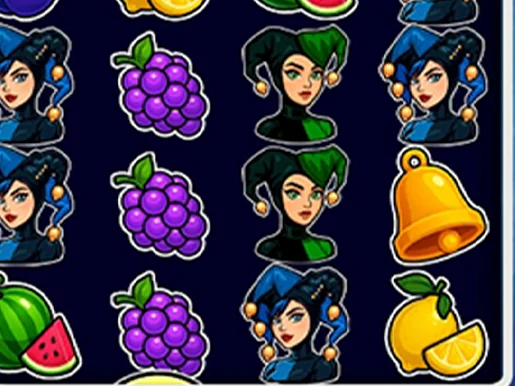
The colours are just as explicit, because the game prints the names in them. Jinxie stands to the left in green. Jest is in the centre in red, carrying a heart-topped sceptre. Luna is to the right in blue. Each colour reappears on the reels as that performer's own paying symbol, which is what lets a glance at the field tell you whose tokens are accumulating.
The studio's own phrasing is that each commands her own colour and her own kind of chaos, pulling tokens and waiting for the right moment to perform. That is a description of a state rather than of a feature: a portrait is either dormant or awake, and the game spends most of its time showing you three dormant ones.
What each one is for, read off the purchase menu
The studio's page names the tiers but never says what any individual performer brings. The game does. Pressing the Buy Bonus control opens a menu of four cards, and three of them carry one portrait each with a named round beneath it: Extra Games, Sticky Games, Boost Games and Mixed Games. The fourth card shows all three performers together.
Matching the cards to the performers is simply reading the portraits, and the colours make it unmistakable. The green card belongs to Jinxie and is headed Extra Games. The red card is Jest's and is headed Sticky Games. The blue card is Luna's and is headed Boost Games. The fourth, with all three, is Mixed Games.
Extra, sticky, boosted: an operator's own catalogue entry for this game describes the three performers in exactly those terms, which is a second source arriving at the same division.
So the names are not a guess about what the tricks do, they are what the game calls them, and the division survives being described twice by two parties who were not copying each other. What they are called is as far as the published record goes, though. Nothing states how long a sticky prize holds, what an extra game adds, or what a boost multiplies — those are the questions the next section is about.
One awake, two awake, three awake
The only published rule connecting the three is how many are up at once, and the studio states it in three short sentences. Wake one and the Free Games begin. Wake two and the tricks get mixed. Wake all three at once and the Triple Games bonus takes the stage, with every special symbol firing together.
Read carefully, that is a statement about scope rather than about size. One awake performer gives a round built around one behaviour. Two give a round in which two behaviours are live in the same sequence. Three give a round in which the whole symbol set is live. Nothing in it promises that three is worth three times one, and nothing in it is a statement about odds.
It also explains why the purchase menu has four cards rather than three: the fourth is the three-performer tier sold directly, under the name Mixed Games. Buying a tier and reaching it through play are two routes to the same round, and the game draws no distinction between them on screen.
What is not said about them anywhere
No source published by anybody gives a token requirement, a wake frequency, a hit rate, or a price for any of the four purchase cards. Our captures show the menu but not its prices. The studio's description stops at the three sentences above. The catalogues that carry the game copy the same sentences and add nothing.
There is also no return-to-player percentage for this title at all, which matters more here than it looks. On a game sold through a purchase menu, the figure people most want is the one that says what the purchase is worth — and for Joker Tricks that figure has never been published, by the studio or by anyone else. It is not a withheld range. It is absent.
Where that leaves a reader is honest enough: the three performers are a well-documented piece of design and a completely undocumented piece of mathematics. This site writes down the first and refuses to invent the second.
What people want settled about the three
- Who are Jinxie, Jest and Luna?
The three performers standing above the reel field. The studio names them and the game labels each portrait.
- Which colour belongs to whom?
Jinxie green, Jest red, Luna blue, in the colours their on-screen labels are printed in.
- What does each one do?
The bonus menu sells one named round behind each portrait: Extra, Sticky and Boost Games.
- What happens when two wake?
The studio says the tricks get mixed: both behaviours run in the same sequence.
- What happens when all three wake?
Triple Games opens, with every special symbol firing together.
- Do the three appear on the reels as well?
Yes, each as a paying symbol in her own colour.
- How often does a performer wake?
Unpublished. No source gives trigger odds or a token count.
Carry on from here
The rounds they open are set out under Free Games and Triple Games. What their tricks actually do to a spin is on the marks, and the field they stand over is measured on the ways page.